Creative technology (or CreaTech) is changing the ways that we make, share and experience culture, communities and workplaces. CreaTech offers new platforms to engage in performance, new opportunities for creative expression and new avenues for employment and skills personal development. CreaTech is rooted in innovation, be it innovative tools, platforms, Ai and processes, however innovation is not just about what is possible, it’s also about why we should innovate, how we innovate, who will benefit from the innovation and what does a sustainable innovative future look like. This is where Responsible Innovation (RI) plays its part.
RI can be defined as “ a transparent, interactive process in which societal actors and innovators become mutually responsive to each other with a view on the (ethical) acceptability, sustainability and societal desirability of the innovation process and its marketable products (in order to allow a proper embedding of scientific and technologies advances in our society)” Von Schomberg (2011)
CreaTech Frontiers is a five-year, £7.2 million project supporting creative technology innovation across the West Midlands. Led by Birmingham City University and delivered with partners including Coventry University, the University of Birmingham, the University of Warwick, the Royal Shakespeare Company and Digital Catapult. The programme is designed to grow a creative technology ecosystem in the region, strengthen the community and bring together research and development, business support, skills development and creative collaboration, with inclusion, ethics and sustainability at its core.
For CreaTech Frontiers, RI means making sure that new creative technologies are developed in ways that are trustworthy, inclusive, sustainable and useful to the people and communities they are designed to serve.
Trusting Innovation
Trust is central to responsible innovation. People are more likely to engage with new technologies, creative experiences or research projects when they feel confident that these have been developed openly, fairly and carefully and that the outputs are of value.
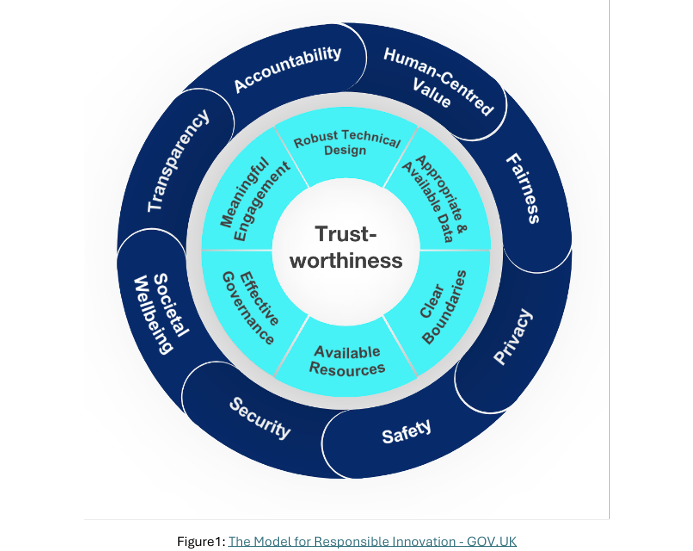
The UK Government’s Responsible Technology Adoption Unit (RTA) has developed a model for Responsible Innovation (https://www.gov.uk/government/publications/the-model-for-responsible-innovation/the-model-for-responsible-innovation), designed to help teams think through the ethical risks and opportunities involved in data-driven and AI projects. While developed for data centric projects, it’s application in CreaTech is straightforward to see. CreaTech is centred around the trustful use of data, be it data from creatives, from productions from audiences or from the community itself.
The RTA model is built around three key parts: the Fundamentals, the Conditions, and the central goal of Trustworthiness.
For CreaTech Frontiers, trustworthiness is not only about the final technology, product or creative outcome. It is also about the processes behind it: how decisions are made, how communities are involved, how risks are considered, and how learning is shared.
Specifically, we can ask ourselves
What are we trying to achieve, and who is it for?
Who might be affected by this work?
Have the right people been included in the conversation?
Are we being transparent about our decisions?
How are we considering equality, diversity, sustainability and fairness?
How will we know whether we are doing this responsibly?
These questions matter at every stage of CreaTech frontiers, from project governance and funding decisions through to research, development, testing, delivery and evaluation.
The Fundamentals of Responsible Innovation
The RTA model sets out eight “Fundamentals” that help teams like CreaTech frontiers, think about responsible innovation in a standardised way. These are useful for projects involving AI, data and disruptive technologies, but they can also support wider creative technology work.
For CreaTech Frontiers, these fundamentals provide a useful foundation for thinking about responsible creative technology:
Transparency
Being open about processes, decisions and project stages, and sharing meaningful information with the people who need it.
Accountability
Making sure there is clear governance, oversight and responsibility throughout the life of a project.
Human-centred value
Ensuring that projects have a clear purpose and benefit for people, and that they are designed with human needs in mind.
Fairness
Considering what fairness means in each project and checking whether outcomes are fair in practice.
Privacy
Respecting people’s personal data and making sure privacy is protected.
Safety
Ensuring that technologies, processes and activities work reliably and do not create unnecessary physical, emotional or social harm.
Security
Making sure systems, processes and data are protected from unauthorised access or misuse.
Societal wellbeing
Thinking about the wider impact of innovation on communities, culture, society and the planet.
Importantly, responsible innovation is not a tick box exercise. Not every project will engage with each fundamental in the same way or to the same degree. For examples a local west midlands community arts project may have a different set of challenges, risks, stakeholders and needs. Complimentary a global AI production tool or a novel live and immersive theatre prototype may all have different risks, needs and responsibilities.
The key is to make these considerations measurable, scalable, visible and create a platform for people to openly discuss them and assess them periodically as projects develop.
Embedding and assessing Responsible Innovation
One challenge with responsible innovation is that principles may appear logical but can be challenging to implement. Additionally, many elements of responsible innovation can scrutinise the innovation process, potentially making us question our own personal motivators for innovation and product development.
CreaTech Frontiers is addressing this by developing onto the RTU responsible innovation framework, shaping it so that can be applied across different parts of the programme.
To do this, we are using a Capability Maturity Model (CMM) which can assess responsible innovation periodically.
CMMs are simple to implement and helps us understand how developed or mature a process is. Rather than asking whether something is simply “responsible” or “not responsible”, it helps us ask
where are we now, and how can we improve?
It also supports reflective questioning of our position at periodic intervals in the project lifecycle and can be useful for advising on best practices in responsible innovation.
A maturity model for responsible innovation
The CreaTech Frontiers approach uses five levels of maturity:
1. Initial
Processes are informal, inconsistent or reactive. Responsible innovation may be happening, but it is not yet clearly planned or documented.
2. Repeatable
Some processes are in place and can be repeated, but they may still depend on particular people, moments or project stages.
3. Defined
Processes are clearly described and documented. Teams have a shared understanding of what responsible innovation involves.
4. Managed
Processes are actively measured, reviewed and adapted. There is evidence that responsible innovation is being applied in practice.
5. Optimising
Responsible innovation is embedded across the project and continuously improved over time.
Importantly though this capability and maturity model recognises that projects change. It also recognises the diverse maturity teams may be in and acknowledges that not all teams have the same capability. For example:
a team may be strong in one area (say EDI) and still developing in another.
a community project in Coventry, might have strong community engagement aspect but need more work on data privacy.
a local tech company experienced in creating novel immersive tools for audience engagement might have clear governance and data handling processes but need to improve how it measures sustainability of their environmental footprint when using Ai.
The six pillars of CreaTech Frontiers
The responsible innovation framework is being applied within the CreaTech Frontiers project across six core pillars of activity.
Strategic Foundation
Clarifying the purpose of the project and making sure it aligns with creative value, societal benefit and responsible innovation commitments.
Project Leadership
Embedding responsible innovation into leadership, meetings, planning and formal evaluation.
Programme Design
Supporting co-design with stakeholders and building reflection, future thinking and scenario planning into programme development.
Reviewer Framework
Creating a transparent and scalable assessment process for research and development activity, from application through to award and final review.
R&D Activity
Providing guidance and support so that funded projects can develop in sustainable, inclusive and responsible ways.
Monitoring
Reviewing processes and outcomes internally and externally and using that learning to improve future work.
Together, these pillars help make responsible innovation part of the everyday structure of CreaTech Frontiers, rather than something added at the end. It also allows us to assess our capability and maturity to deliver responsible innovation for the community.
We have a commitment to Responsible Innovation
We all have a commitment to responsible innovation. In CreaTech frontiers our commitment is to provide platforms, tools, opportunities and processes for us to consider responsible innovation. We also have a self reflective honest commitment to responsible innovation, were we measure and reflect on the maturity in our journey.
Our aim in CreaTech Frontiers is not to slow innovation down or make it harder to innovate, but it is to create the platform for improved, equitable innovation that we all trust and that supports measurable long-term creative, social and environmental value. We want to move from creating things that excite us to making things that offer a future which excites and inspires us all.
Von Schomberg, R. 2011. Towards Responsible Research and Innovation in the Information and Communication Technologies and Security Technologies Fields. Luxembourg: Publications Office of the European Union. http://ec.europa.eu/research/science-society/document_library/ pdf_06/mep-rapport-2011_en.pdf.